

Backhoe loader
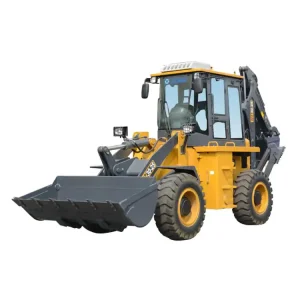
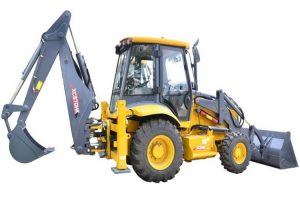
A backhoe loader , also called a backhoe loader, backhoe loader , excavator in layman’s terms or colloquially shortened to backhoe loader in the industry, is a heavy vehicle consisting of a tractor-like unit equipped with a shovel/bucket in loader style. in front and a backhoe in the back. Due to their (relatively) small size and versatility, backhoe loaders are very common in urban construction.and small construction projects (eg construction of a small house, repair of urban roads, etc.) as well as developing countries. This type of machine is similar to what is now known as a TLB (tractor-loader-backhoe), i.e. an agricultural tractor equipped with a front loader and a rear backhoe.
The real development of the backhoe actually began in 1947 by the inventors who founded the Wain-Roy Corporation in Hubbardston, Massachusetts. In 1947, the Wain-Roy Corporation developed and tested the first true backhoe loaders. In April 1948, the Wain-Roy Corporation sold the very first fully hydraulic backhoe loaders mounted on a Ford Model 8N tractor to the Connecticut Light and Power Company for $705.
Story
.jpg)
Developing in parallel with US developments, backhoe loaders were first produced in the UK in 1953 by JCB, but this was only a prototype. The world’s first factory-warranted backhoe loader was introduced in the US by JI Case in 1957. Their Model 320 was the world’s first mass-produced backhoe loader. Although the backhoe loader is based on a tractor, it has almost never been and is not called a tractor . if both loader and backhoe loader are permanently attached. Backhoe loaders are also not commonly used for towing and usually do not have a power take-off (PTO), as it is often used to drive the hydraulic pump that drives the attachment. When the backhoe is permanently attached, the machine usually has a seat that can pivot back to face the cultivator’s controls. Removable backhoe attachments almost always have a separate seat on the attachment itself.

Typical European backhoe loader; they usually have a side-shift backhoe mount and vertical stabilizers.
In the UK and Ireland they are usually used by JCBs; in India they are commonly used «JCB». In China they are usually used as «XCMG», although the term «backhoe loader» refers to only one component.
In 1970, Hy-Dynamic, now a division of Bucyrus-Erie, the manufacturer of Dynahoe, became the first company to introduce an all-wheel drive system to its backhoe loaders, allowing these models to tackle almost any terrain with ease. Since the invention of the backhoe, several companies such as Caterpillar and John Deere have modified the backhoe’s rear arm to be slightly curved like an excavator, which can allow for greater maneuverability.
Use
Backhoe loaders are very common and can be used for a wide variety of tasks: construction, light demolition, light transport of building materials, powering construction equipment, digging holes/excavations, landscaping, breaking asphalt, and paving roads. Often, the backhoe bucket can also be replaced with a mechanical attachment such as a hydraulic hammer, grapple, auger, or stump grinder. Improved attachment articulation can be achieved with intermediate attachments such as a tiltrotator. Many excavators are equipped with quick-coupling (quick-release) mounting systems and auxiliary hydraulic circuits to simplify the installation of attachments, increasing the efficiency of the machine on the job site. Some loader buckets have a pop-out bottom or «clamshell» design that allows for quicker and more efficient emptying of the load. Retractable bottom loader buckets are also often used for sorting and scraping. The front assembly may be a removable fixture or permanently installed.
Since digging on tires inherently causes the machine to sway and the rocking weight of the backhoe can cause the machine to tip over, most backhoe loaders use hydraulic outriggers or stabilizers at the rear when digging and lower the loader bucket for added stability. This means the bucket must be raised and the outriggers retracted when the vehicle needs to change position, reducing efficiency. For this reason, many companies offer miniature crawler excavators that sacrifice loader function and the ability to move from place to place to improve digging efficiency.
Their relatively small frame and precise handling make backhoe loaders very useful and common in urban engineering projects such as construction and renovation in areas too small for larger equipment. Their versatility and compactness make them one of the most popular urban construction machines. For larger projects, a crawler excavator is usually used.
In recent years, small compact tractors have become very popular among private homeowners. Small tractors between the size of a compact tractor and a lawn mower are also often sold complete with a backhoe loader, sometimes with a belly-mounted mower. These tractors offer private homeowners the ability to do small earthworks.
